WILDFIRE
PROTECTION TIPS FOR SURVIVAL AND PROPERTY
There
are many factors which affect the risk to life and property.
These include property location and access, the amount and
type of nearby vegetation, building position and condition,
availability of water and the physical capabilities of those
involved. In wildfires, radiant heat, dehydration and asphyxiation
(choking) are the major killers. Well-prepared houses can resist
exposure to wildfires, protecting
those inside who may then be able to save their homes.
Protecting
your family and property from fire requires a balanced effort
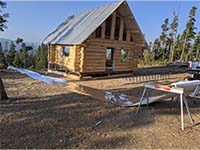
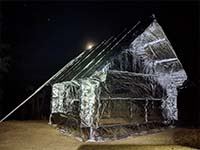
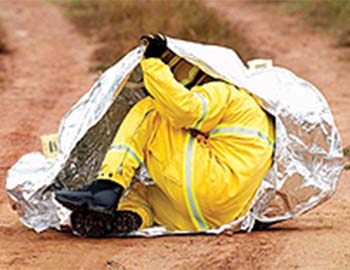
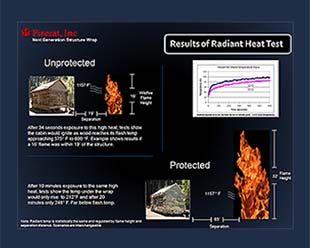
of awareness, education, and preparedness. Using Firezat
Fire Shields to protect your home can improve the chances your
property will survive a threatening wildfire.
It can also provide extra time to allow the fire department
and fire fighters time to save your home. Your chances can
be greatly increased if you follow these tips. Also check
with your local fire department for area specific tips that
they will be happy to share with you.
Important
Fire Facts
Embers
or firebrands threaten your property over a longer period
of time than Radiant Heat or Direct Flame Contact. Direct
Flame Contact and Radiant Heat arrive with the fire front
and will last from 3 to 5 minutes to 10 - 15 minutes depending
on wind speeds and terrain. Ember attack usually occurs up
to 30 minutes prior to the arrival of fire front and for several
hours afterwards. Embers can travel over 1/2 mile in advance
of the winds and be as large as fiery golf balls when they
land on your roof or property and start new fires.
PREPARATION
BEFORE THE BUSHFIRE SEASON
- Create
a defensible area around your home for a minimum of 100
feet or if your home is located on a slope or in high wind
area increase that area to 150 feet. Use a mower, spade,
rake, and trim branches well clear of the house.
-
Clear roof gutters of leaves, twigs etc.
- Store
wood, fuel, paints etc well clear of the house.
-
Remove rubbish, leaf litter and native shrubs close to house.
Keep grass short/green.
-
Store firewood away from your house.
- Prevent
sparks from entering your house by covering vents with wire
mesh no larger than 1/8". Fit
wire screens to doors, windows, vents. Enclose gaps, roof
eaves and under house.
- Keep
a ladder handy for roof access (inside and outside) and
hoses to reach all parts of house and garden. If water is
not connected, obtain a high pressure pump.
- Decide
on a household plan to either leave early or stay to protect
your properly-prepared home during a bushfire.
- Check
to see if you have bushfire insurance and it covers replacement
cost should you lose your home to a wildfire or bushfire.
-
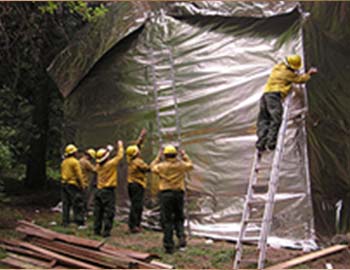
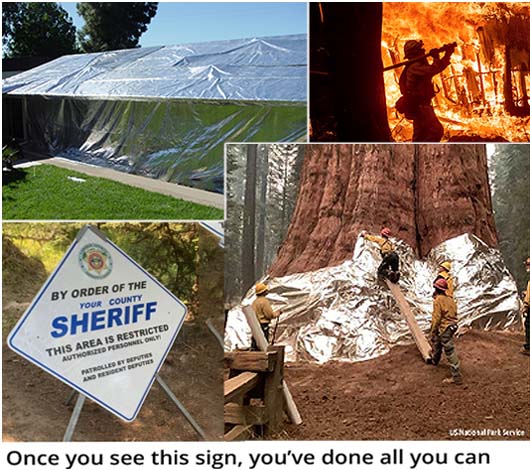
Have a plan to deploy your Firezat Fire Shields and confirm
you have your installation kits and sand bag material handy.
IF
A BRUSHFIRE APPROACHES - Leave or Protect
If
you prepare your house as noted above, and unless you decide
to leave early or have been ordered by authorities to do so,
stay in the house after taking these extra precautions:
- Phone
911 or 000 in Australia- do not assume they know about the
fire.
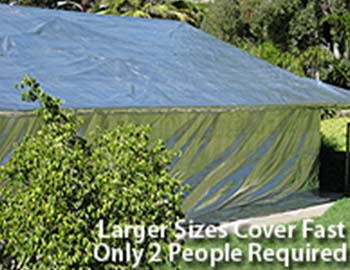
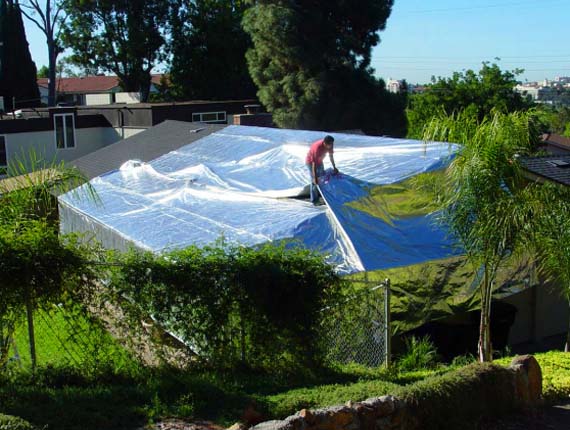
- Deploy
your Firezat House Cover. Secure with stakes, nails,
and sandbags covering all seams.
- Fill
baths, sinks, buckets etc with reserve water and turn off
gas and power.
-
Remove curtains and move furniture away from windows.
- Wear
long woolen or heavy cotton clothes and solid boots or shoes,
a hat or woolen balaclava and gloves.
- Plug
down pipes with rags and fill all roof gutters with water.
Hose down walls, garden, etc on the sides of the house facing
the ‘fire-front’ and watch for spot-fires.
-
Inside, close all windows, doors and block crevices and
gaps. When the fire-front arrives, stay inside, away from
windows, while it passes (usually 5 to 15 minutes).
- Quickly
extinguish any fires which may have started in, on, or under
the house and check inside the roof cavity as well.
- If
the house is alight and can’t be extinguished, move
away to safe burnt ground. Don’t leave the area, wait
for help. Listen to the battery radio for official information.
IF
CAUGHT IN A FIRE, DRIVING - Shelter in Car
-
Don’t drive into or near bushfires. If caught in one
don’t drive through flames or smoke.
- Stop
in an area of low vegetation. Leave motor running and air
conditioner (recycle), hazard lights and headlights on.
- Stay
inside unless near safe shelter. Keep vents, windows and
doors closed. Lie inside, below window level, under a woolen
blanket for skin protection until the fire-front passes.
- Research
shows that in a bushfire, a car fuel tank is unlikely to
explode in the period needed to stay inside the vehicle
using it as a shield against deadly radiant heat of the
fire-front.
- After
the main fire-front passes, if car is on fire or heat and
fumes inside are severe, get out and move to already burnt
ground, keeping your whole body covered with the blanket.
IF
CAUGHT IN FIRE, ON FOOT - Seek Shelter
- Don’t
Panic - cover all exposed skin.
- Move
across-slope, away from the fire-front, then down-slope
towards the rear of the main fire.
- Find
open, or already burnt ground. Don't try to out-run the
fire or run uphill or go through even low flames unless
you can clearly-see a safe area close-by.
- If
you can’t avoid the fire, protect yourself from heat
radiation by lying face down under an embankment, rock,
loose earth, or in a hollow, or if possible get into a pond,
dam or stream - but not into a water tank.
VITAL
POINTS TO REMEMBER
If
you are in a house or car you will be safer than in the open
while the fire-front passes. Stay there, unless advised to
leave by emergency authorities. If caught in the open you
must protect yourself from the radiant heat of flames by every
possible means.
Note:
A heavy, pure wool blanket (to wrap around you) and a flask
of water (to drink and to moisten a corner of the blanket
as a smoke mask) are basic requirements for bushfire survival
and will give protection against radiant heat, dehydration
and asphyxiation even in intense fires.
|